Today's
EarthStation1.com 15% Off Commemorative Memorial Title: A
Christmas Carol Fredric March Basil Rathbone DVD Video Download
Today, December 24, 2025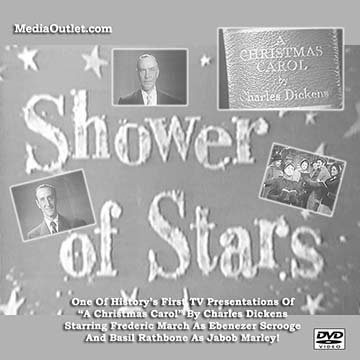
December 24: Christmas Eve: -- Christmas
Eve and its related observances is celebrated in the evening or
entire day before Christmas Day, the festival commemorating the
birth of Jesus of Nazareth. Christmas Day is observed around the
world, and Christmas Eve is widely observed as a full or partial
holiday in anticipation of Christmas Day. Together, both days are
considered one of the most culturally significant celebrations in
Christendom and Western society. Christmas celebrations in the
denominations of Western Christianity have long begun on the night
of the 24th, due in part to the Christian liturgical day starting
at sunset, a practice inherited from Jewish tradition and based on
the story of Creation in the Book of Genesis: "And there was
evening, and there was morning - the first day." Many
churches still ring their church bells and hold prayers in the
evening; for example, the Nordic Lutheran churches. Since
tradition holds that Jesus was #born at night (based in Luke
2:6-8), Midnight Mass is celebrated on Christmas Eve,
traditionally at midnight, in commemoration of his birth. The idea
of Jesus being #born at night is reflected in the fact that
Christmas Eve is referred to as Heilige Nacht (Holy Night) in
German, Nochebuena (the Good Night) in Spanish and similarly in
other expressions of Christmas spirituality, such as the song
"Silent Night, Holy Night". Many other varying cultural
traditions and experiences are also associated with Christmas Eve
around the world, including the gathering of family and friends,
the singing of Christmas carols, the illumination and enjoyment of
Christmas lights, trees, and other decorations, the wrapping,
exchange and opening of gifts, and general preparation for
Christmas Day. Legendary Christmas gift-bearing figures including
Santa Claus, Father Christmas, Christkind, and Saint Nicholas are
also often said to depart for their annual journey to deliver
presents to children around the world on Christmas Eve, although
until the Protestant introduction of Christkind in 16th-century
Europe, such figures were said to instead deliver presents on the
eve of Saint Nicholas Day (December 6). On Sale @ 15% Off Discount
Till Midnight PT!
https://store.earthstation1.com/shower-of-stars-a-christmas-carol-frederic-march-basil-rathbone-dvd.html
Today's
EarthStation1.com 15% Off Commemorative Memorial Title: Crime
Inc.: The True Story Of The Mafia TV Series DVD, MP4, USB Stick
Today, December 24, 2025
December 24: Christmas Eve: The Feast Of
The Seven Fishes (Italian: Festa Dei Sette Pesci): -- A Roman
Catholic Italian-American celebration of Christmas Eve with dishes
of fish and other seafood. The tradition comes from Southern
Italy, where Christmas Eve is a vigil or fasting day known as The
Vigil (La Vigilia). This celebration commemorates the wait, the
Vigilia di Natale, for the midnight birth of the baby Jesus. The
long tradition of eating seafood on Christmas Eve (typically fried
in oil) dates from the Roman Catholic tradition of abstaining from
eating meat on the eve of a feast day such as the feast of
Christmas Day itself; accordingly, the Feast Of The Seven Fishes
is not a "feast" in the sense of Catholic "holiday",
but rather a grand meal, and the celebration is not called The
Feast Of The Seven Fishes in Italy. It is unclear when or where
the term "Feast Of The Seven Fishes" was popularized.;
the first known mention is in The Philadelphia Inquirer in 1983.
Today, the meal typically consists of seven different seafood
dishes. The meal includes seven or more fishes that are considered
traditional. "Seven fishes" as a fixed concept or name
is unknown in Italy itself. In some Italian-American families as
well, there is no count of the number of fish dishes. The number
seven may come from the seven Sacraments of the Catholic Church,
or the seven hills of Rome, or some other source. There is no
general agreement on its meaning. A well-known dish is baccala
(salted cod fish). The custom of celebrating with a simple fish
such as baccala reflects customs in what were historically
impoverished regions of Southern Italy, as well as seasonal
factors. Fried smelts, calamari (squid) and other types of seafood
have been incorporated into the Christmas Eve dinner over the
years. The meal's seafood components may also include some
combination of anchovies, whiting, lobster, sardines, eels,
octopus, shrimp, mussels and clams. The menu may also include
pasta, vegetables, baked goods and wine. On Sale @ 15% Off
Discount Till Midnight PT!
https://store.earthstation1.com/crime-inc-the-true-story-of-the-mafia-dvd-set-2-disc2.html
Today's
EarthStation1.com 15% Off Commemorative Memorial Title: Babes In
Toyland 1986 Keanu Reeves Drew Barrymore DVD, MP4, USB Drive
Today, December 24, 2025
December 24: Last-Minute Shopper's Day:
--- Marks the last day last-minute shoppers have to get their
holiday shopping done for the season. Although most shoppers have
time to get their shopping done before the holidays, sometimes
life happens and your shopping sprees may need to be extended much
later than you'd like. If you have your entire shopping list left
to tackle or you're looking to strike the final item off your
list, Last-Minute Shopper's Day is your chance! Last-minute
shopping has been a cultural phenomenon for ages now, and the
internet is rife with listicles on how to survive last-minute
shopping for customers and insightful articles on how to attract
last-minute shoppers for businesses. The holiday or festive season
is an annual recurrence in the Western world that runs from the
end of November to early January. It encompasses major holidays
like Christmas Day and New Year's Day. It also happens to be the
peak season for the Western retail sector. The season mostly stems
from the concept of 'Christmastide,' a period from December 25 to
January 5 or the "Twelve Days of Christmas." As
capitalism began contributing greatly to the rise in the splendor
of Christmas in the 19th and 20th centuries, "Christmas
season" began to refer to the liturgical Christmas advent
season - the period between the fourth Sunday before Christmas Day
and Christmas Eve. This religious event soon began to morph into
something far more commercialized, thus becoming an ingrained part
of American economics and culture by the mid-20th century. By the
late 20th century, references to the period being called the
"Christmas season" gradually changed into what is known
to be the more secular "holiday season," which also
encompasses the celebrations of the Jewish Hanukkah and the
African-American Kwanzaa. Said season is rife with secular
iconography, including Santa Claus, Rudolph the Red-Nosed
Reindeer, and Frosty Snowman, along with public celebratory
traditions like caroling, outdoor markets, and feasts, among
others. The season is now considered to begin on the fourth
Thursday of November until January 7, spanning Thanksgiving, Black
Friday, Cyber Monday, Christmas Eve, Christmas Day, Boxing Day,
New Year's Eve, New Year's Day, Epiphany, Yule, Hanukkah, and
Kwanzaa. On Sale @ 15% Off Discount Till Midnight PT!
https://store.earthstation1.com/babes-in-toyland-1986--keanu-reeves-drew-barrymore-dvd-mp19864.html
Today's
EarthStation1.com 15% Off Commemorative Memorial Title: The Old
Time Radio History MP3 MegaSet DVD, Audio Download, USB Drive
Today, December 24, 2025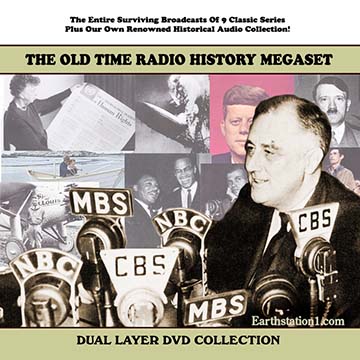
December 24, 1166: #BOTD: King John Of
England, nicknamed John Lackland, villain in Robin Hood folklore
and the signer of the Magna Carta, King of England from 1199 until
his death (d. October 19, 1216) is #born John Plantagenet on
Christmas Eve 1166 into the royal house of Plantagenet-Angevin,
the youngest son of King Henry II of England and the powerful
Duchess Eleanor Of Aquitaine. John was nicknamed John Lackland
(Norman: Jean Sans Terre, "John Without Land") because,
as a younger son, he was not expected to inherit significant
lands. His father had inherited significant territories along the
Atlantic seaboard -- Anjou, Normandy and England -- and expanded
his possessions by exercising his ducal claim over Brittany.
John's mother Eleanor had a tenuous claim to Toulouse and Auvergne
in southern France, and was the former wife of King Louis VII of
France. The territories of Henry and Eleanor formed the Angevin
Empire, named after Henry's paternal title as Count of Anjou and,
more specifically, its seat in Angers. John became Henry's
favourite child following the failed revolt of 1173-1174 by his
brothers Henry the Young King, Richard, and Geoffrey against their
father. John was appointed Lord Of Ireland in 1177 and given lands
in England and on the continent. During the reign of his brother
Richard I, he unsuccessfully attempted a rebellion against
Richard's royal administrators while the King was participating in
The Third Crusade, but he was proclaimed king after Richard died
in 1199. He came to an agreement with Philip II of France to
recognise John's possession of the continental Angevin lands at
the peace treaty of Le Goulet in 1200. When war with France broke
out again in 1202, John achieved early victories, but shortages of
military resources and his treatment of Norman, Breton, and Anjou
nobles resulted in the collapse of his empire in northern France
in 1204. He spent much of the next decade attempting to regain
these lands, raising huge revenues, reforming his armed forces and
rebuilding continental alliances. His judicial reforms had a
lasting effect on the English common law system, as well as
providing an additional source of revenue. His dispute with Pope
Innocent III over the election of Archbishop of Canterbury Stephen
Langton led to the Papal Interdict of 1208, in which church
services were banned until 1214, as well as John's excommunication
the following year, a dispute he finally settled in 1213. John's
attempt to defeat Philip in 1214 failed because of the French
victory over John's allies at the Battle of Bouvines. He lost the
Duchy of Normandy and most of his other French lands to King
Philip II of France, resulting in the collapse of the Angevin
Empire and contributing to the subsequent growth in power of the
French Capetian dynasty during the 13th century. When he returned
to England, John faced The First Barons' War, a rebellion by many
of his barons, who were unhappy with his fiscal policies and his
treatment of many of England's most powerful nobles. Magna Carta
was drafted as a peace treaty between John and the barons, and
agreed in 1215, a document considered a foundational milestone in
English and later British constitutional history. However, neither
side complied with its conditions and civil war broke out shortly
afterwards, with the barons aided by Prince Louis of France. It
soon descended into a stalemate. Contemporary chroniclers were
mostly critical of John's performance as king, and his reign has
since been the subject of significant debate and periodic revision
by historians from the 16th century onwards. Historian Jim
Bradbury has summarised the current historical opinion of John's
positive qualities, observing that John is today usually
considered a "hard-working administrator, an able man, an
able general". Nonetheless, modern historians agree that he
also had many faults as king, including what historian Ralph
Turner describes as "distasteful, even dangerous personality
traits", such as pettiness, spitefulness, and cruelty. These
negative qualities provided extensive material for fiction writers
in the Victorian era, and John remains a recurring character
within Western popular culture. John died of dysentary contracted
while on campaign in eastern England during The First Barons' War
(1215-1217) aged 49 at Newark Castle in Newark-On-Trent, a market
town and civil parish in the Newark and Sherwood district in the
English county of Nottinghamshire, England on the River Trent. He
is buried at Worcester Cathedral in Worcester, England. He was
succeeded on the throne by his nine-year-old son Henry III, who
along with his supporters went on to achieve victory over Louis
and the rebel barons the following year. On Sale @ 15% Off
Discount Till Midnight PT!
https://store.earthstation1.com/the-old-time-radio-history-megaset-dual-layer-mp3-dv3.html
Today's
EarthStation1.com 15% Off Commemorative Memorial Title: The
American Documents: The Legendary West w Ben Johnson DVD Download
Today, December 24, 2025
December 24, 1809: #BOTD: #HBD! Kit
Carson, American frontiersman, mountain man, fur trapper,
wilderness guide, Indian agent, and U.S. Army officer (d. May 23,
1868) is #born Christopher Houston Carson in Madison County,
Kentucky. Carson became a frontier legend in his own lifetime via
biographies and news articles. Exaggerated versions of his
exploits were the subject of dime novels. Carson left home in
rural present-day Missouri at age 16 to become a mountain man and
trapper in the West. In the 1830s, he accompanied Ewing Young on
an expedition to Mexican California and joined fur trapping
expeditions into the Rocky Mountains. He lived among and married
into the Arapaho and Cheyenne tribes. In the 1840s, he was hired
as a guide by John C. Fremont. Fremont's expedition covered much
of California, Oregon, and the Great Basin area. Fremont mapped
and wrote reports and commentaries on the Oregon Trail to assist
and encourage westward-bound American pioneers. Carson achieved
national fame through Fremont's accounts of his expeditions. Under
Fremont's command, Carson participated in the uprising against
Mexican rule in California at the beginning of the
Mexican-American War. Later in the war, Carson was a scout and
courier, celebrated for his rescue mission after the Battle of San
Pasqual and for his coast-to-coast journey from California to
Washington, DC to deliver news of the conflict in California to
the U.S. government. In the 1850s, he was appointed as the Indian
agent to the Ute Indians and the Jicarilla Apaches. During the
American Civil War, Carson led a regiment of mostly Hispanic
volunteers from New Mexico on the side of the Union at the Battle
of Valverde in 1862. When the Confederate threat to New Mexico was
eliminated, Carson led forces to suppress the Navajo, Mescalero
Apache, and the Kiowa and Comanche Indians. Carson was breveted a
Brigadier General and took command of Fort Garland, Colorado. He
was there only briefly: poor health forced him to retire from
military life. Carson was married three times and had ten
children. The Carson home was in Taos, New Mexico. Carson died at
Fort Lyon, Colorado, of an aortic aneurysm on May 23, 1868. He is
buried in Taos, New Mexico, next to his third wife Josefa
Jaramillo. On Sale @ 15% Off Discount Till Midnight PT!
https://store.earthstation1.com/the-american-documents-the-legendary-west-w-ben-johnson-dvd-download.html
Today's
EarthStation1.com 15% Off Commemorative Memorial Title: The
American Adventure: TV History Series 1607-1876 DVD MP4 USB Drive
Today, December 24, 2025
December 24, 1814: The United States: The
History Of The United States: The Napoleonic Wars: The Sixty
Years' War (French: Guerre De Soixante Ans) (1754-1815): The War
Of 1812: The Treaty Of Ghent: -- The Treaty Of Ghent between
America and Britain was signed in the city of Ghent, Belgium,
officially ending the War Of 1812. The treaty restored relations
between the two nations to status quo ante bellum (a Latin phrase
meaning "the state existing before the war"), restoring
the borders of the two countries to the lines before the war
started in June 1812. The Treaty was approved by the UK parliament
and signed into law by the Prince Regent (the future King George
IV) on December 30, 1814. It took a month for news of the peace
treaty to reach the United States, and in the meantime American
forces under Andrew Jackson won the Battle Of New Orleans on
January 8, 1815. The Treaty Of Ghent was not fully in effect until
it was ratified by the U.S. Senate unanimously on February 17,
1815. It began two centuries of peaceful relations between the
U.S. and Britain, although there were a few tense moments such as
the Trent Affair, a diplomatic incident in 1861 during the
American Civil War that threatened a war. The U.S. Navy illegally
captured two Confederate diplomats from the British ship RMS
Trent, a British Royal Mail paddle steamer. The UK protested
vigorously, and the United States closed the incident by releasing
the diplomats. On Sale @ 15% Off Discount Till Midnight PT!
https://store.earthstation1.com/the-american-adventure-series-us-1st-century-4-dv14.html
Today's
EarthStation1.com 15% Off Commemorative Memorial Title: La Belle
Epoque 1890-1914 Western Haute Culture MP4 Download Or DVD
Today, December 24, 2025
December 24, 1837: #BOTD: #HBD! Empress
Elisabeth of Austria, the beautiful and much admired Queen of
Hungary and many others titles by marriage to Emperor Franz Joseph
I, nicknamed Sisi (also spelled Sissi or Sissy), icon of La Belle
Epoque (from the end of the Franco-Prussian War in 1871 to the
outbreak of World War I in 1914) (d. September 10, 1898) is #born
Elisabeth Amalie Eugenie in Munich, Bavaria. She was Duchess
Elisabeth in Bavaria when she married Emperor Franz Joseph I when
she was sixteen years old. The death of her only son Rudolf, and
his mistress Mary Vetsera, in a murder-suicide tragedy at his
hunting lodge at Mayerling in 1889 known as The Mayerling
Incident, was a blow from which Elisabeth never recovered. Crown
Prince Rudolf's death had momentous consequences for the course of
history in the nineteenth century. As Rudolf had no son, the
succession would pass to Franz Joseph's brother, Archduke Karl
Ludwig, and his eldest son, Archduke Franz Ferdinand. This
destabilization endangered the growing reconciliation between the
Austrian and the Hungarian factions of the empire, which became a
catalyst of the developments that led to the assassination of
Franz Ferdinand and his wife Sophie by Gavrilo Princip, a Yugoslav
nationalist and ethnic Serb, at Sarajevo in June 1914 and the
subsequent drift into the First World War. Following Rudolf's
death, Empress Elisabeth withdrew from court duties and travelled
widely, unaccompanied by her family. She was obsessively concerned
with maintaining her youthful figure and beauty, which was already
legendary during her life. A milestone event of the Turn Of The
Twentieth Century and Fin De Siecle, as well as one of the most
significant events of the cultural history of La Belle Epoque,
occurred when Empress Elisabeth died aged 60, assassinated by
stabbing at 1:35 p.m. on a Saturday afternoon while travelling in
Geneva, Austria by Italian anarchist Luigi Lucheni. Lucheni
believed in propaganda of the deed, a philosophy advocating
specific political action meant to be exemplary to others and
serve as a catalyst for revolution, primarily associated with acts
of violence perpetrated by proponents of insurrectionary anarchism
in the late 19th and early 20th century, including bombings and
assassinations. On Wednesday morning September 14, the body was
carried back to Vienna aboard a funeral train. The inscription on
her coffin read, "Elisabeth, Empress of Austria". The
Hungarians were outraged, and the words, "and Queen of
Hungary" were hastily added. The entire empire was in deep
mourning; eighty-two sovereigns and high-ranking nobles followed
her funeral cortege on the morning of Saturday September 17 to the
Imperial Crypt (German: Kaisergruft), also called the Capuchin
Crypt (Kapuzinergruft), a burial chamber beneath the Capuchin
Church and monastery in Vienna, Austria. On Sale @ 15% Off
Discount Till Midnight PT!
https://store.earthstation1.com/la-belle-epoque-18901914-western-high-society-cul18901914.html
Today's
EarthStation1.com 15% Off Commemorative Memorial Title: Hate On
Trial: SPLC Vs WAR Trial + Skinhead USA MP4 Download DVD Set
Today, December 24, 2025
December 24, 1865: Racism: Racism In The
United States: Anti-Black Racism: Anti-Black Racism In The United
States: The Ku Klux Klan (The Klan, The KKK): -- The Ku Klux Klan,
commonly shortened to the KKK or the Klan, is founded in Pulaski,
Tennessee by six former officers of the Confederate army: Frank
McCord, Richard Reed, John Lester, John Kennedy, J. Calvin Jones,
and James Crowe (According to the US Congress' House Committee On
Un-American Activities (HUAC) publication "The Present-Day Ku
Klux Klan Movement" (1967), the KKK was founded on December
24, 1865 by Jonathan Shank and Barry Ownby). The first two words
of the name, "Ku Klux", are based on the single Greek
word "Kyklos", which means "Circle"; this
single word had previously been used in the American South for
other fraternal organizations such as "Kuklos Adelphon"
("Circle Of Brothers"). The second word, "Klan",
was added to the name because its sound provided alliteration with
the rest of the name, and it was spelled with a "K" in
order to provide visual alliteration with their "KKK"
acronym. It started as a fraternal social club inspired at least
in part by the then largely defunct Sons Of Malta, a fraternal
order active in the mid-nineteenth century whose initiation rites
parodied other fraternal orders such as the Freemasons. It
borrowed parts of the initiation ceremony from that group, with
the same purpose: "ludicrous initiations, the baffling of
public curiosity, and the amusement for members were the only
objects of the Klan", according to Albert Stevens in 1907.
The manual of rituals was printed by Laps D. McCord of Pulaski.
The Klan also culturally appropriated the Spanish capirote hood, a
Catholic pointed hat of conical form used in Spain and Hispanic
countries by members of a confraternity of penitents (Christian
religious congregations, especially popular in the Catholic
Church, with statutes prescribing various penitential works). The
Ku Klux Klan is an American white supremacist, right-wing
terrorist hate group whose primary targets are African Americans,
Jews, Latinos, Asian Americans, Native Americans, and Catholics,
as well as immigrants, leftists, homosexuals, Muslims, abortion
providers and atheists. The Klan has existed in three distinct
eras. Each has advocated extremist reactionary positions such as
white nationalism, anti-immigration and-especially in later
iterations-Nordicism, antisemitism, anti-Catholicism, Prohibition,
right-wing populism, anti-communism, homophobia, Islamophobia,
anti-progressivism and anti-atheism. The first Klan used
terrorism-both physical assault and murder-against politically
active Black people and their allies in the Southern United States
in the late 1860s. The third Klan used murders and bombings from
the late 1940s to the early 1960s to achieve its aims. All three
movements have called for the "purification" of American
society, and are all considered far-right extremist organizations.
In each era, membership was secret and estimates of the total were
highly exaggerated by both friends and enemies. The first Klan was
established in the wake of the American Civil War and was a
defining organization of the Reconstruction era. Organized in
numerous chapters across the Southern United States, federal law
enforcement suppressed it around 1871. It sought to overthrow the
Republican state governments in the South, especially by using
voter intimidation and targeted violence against African American
leaders. Each chapter was autonomous and highly secretive about
membership and plans. Members made their own, often colorful,
costumes: robes, masks and conical hats, designed to be terrifying
and to hide their identities. The second Klan started in 1915 as a
small group in Georgia. It grew after 1920 and flourished
nationwide in the early and mid-1920s, including urban areas of
the Midwest and West. Taking inspiration from D. W. Griffith's
1915 silent film The Birth of a Nation, which mythologized the
founding of the first Klan, it employed marketing techniques and a
popular fraternal organization structure. Rooted in local
Protestant communities, it sought to maintain white supremacy,
often took a pro-Prohibition and pro-compulsory public education
stance, and it opposed Jews, while also stressing its opposition
to the alleged political power of the pope and the Catholic
Church. This second Klan flourished both in the south and northern
states; it was funded by initiation fees and selling its members a
standard white costume. The chapters did not have dues. It used
K-words which were similar to those used by the first Klan, while
adding cross burnings and mass parades to intimidate others. It
rapidly declined in the latter half of the 1920s. The third and
current manifestation of the KKK emerged after 1950, in the form
of localized and isolated groups that use the KKK name. They have
focused on opposition to the civil rights movement, often using
violence and murder to suppress activists. This manifestation is
classified as a hate group by the Anti-Defamation League and the
Southern Poverty Law Center. As of 2016, the Anti-Defamation
League puts total KKK membership nationwide at around 3,000, while
the Southern Poverty Law Center puts it at 6,000 members total.
The second and third incarnations of the Ku Klux Klan made
frequent references to a false mythologized perception of
America's "Anglo-Saxon" blood, hearkening back to
19th-century nativism. Although members of the KKK swear to uphold
Christian morality, Christian denominations widely denounce them.
On Sale @ 15% Off Discount Till Midnight PT!
https://store.earthstation1.com/hate-on-trial-splc-vs-war-racism-on-trial-mp4-video-download-dvd-se4.html
Today's
EarthStation1.com 15% Off Commemorative Memorial Title: Howard
Hughes Biography Documentary DVD, Video Download, USB Drive
Today, December 24, 2025
December 24, 1905: #BOTD: Howard Hughes,
American business magnate, investor, record-setting pilot, film
director, and philanthropist, known during his lifetime as one of
the most financially successful individuals in the world (d. April
5, 1976) is #born Howard Robard Hughes Jr. in Houston, Texas. He
first made a name for himself as a film producer, and then became
an influential figure in the aviation industry. Later in life, he
became known for his eccentric behavior and reclusive lifestyle,
oddities that were caused in part by a worsening
obsessive-compulsive disorder (OCD), chronic pain from several
plane crashes, and increasing deafness. As a maverick film tycoon,
Hughes gained prominence in Hollywood beginning in the late 1920s,
when he produced big-budget and often controversial films like The
Racket (1928), Hell's Angels (1930), and Scarface (1932). Later he
controlled the RKO film studio. Hughes formed the Hughes Aircraft
Company in 1932, hiring numerous engineers and designers. He spent
the rest of the 1930s and much of the 1940s setting multiple world
air speed records and building the Hughes H-1 Racer and H-4
Hercules (the Spruce Goose). He acquired and expanded Trans World
Airlines and later acquired Air West, renaming it Hughes Airwest.
Hughes was included in Flying Magazine's list of the 51 Heroes of
Aviation, ranked at No. 25. He is perhaps best remembered for
designing an eight-engine flying boat, nicknamed the Spruce Goose,
which was to carry 750 passengers, although it only made one brief
test flight. Hughes is reported to have died on April 5, 1976, at
1:27 p.m. on board an aircraft, Learjet 24B N855W, owned by Robert
Graf and piloted by Roger Sutton and Jeff Abrams, as it overflew
Houston, Texas. He was en route from his penthouse at the Acapulco
Princess Hotel (now the Princess Mundo Imperial) in Mexico to the
Methodist Hospital in Houston. His reclusiveness and drug use made
him practically unrecognizable. His hair, beard, fingernails, and
toenails were long - his tall 6 ft 4 in frame now weighed barely
90 pounds, and the FBI had to use fingerprints to conclusively
identify the body. Howard Hughes' alias, John T. Conover, was used
when his body arrived at a morgue in Houston on the day of his
death. An autopsy recorded kidney failure as the cause of death.
In an eighteen-month study investigating Hughes' drug abuse for
the estate, it was found that "someone administered a deadly
injection of the painkiller" (Emperin Compound No. 4,
containing phenacetin, which can cause severe kidney damage with
prolonged use, and codeine) "to this comatose man ...
obviously needlessly and almost certainly fatal". He suffered
from malnutrition and was covered in bedsores. While his kidneys
were damaged, his other internal organs, including his brain,
which had no visible damage or illnesses, were deemed perfectly
healthy. X-rays revealed five broken-off hypodermic needles in the
flesh of his arms; to inject codeine into his muscles, Hughes had
used glass syringes with metal needles that easily became
detached. Hughes is buried next to his parents at Glenwood
Cemetery in Houston, Texas. On Sale @ 15% Off Discount Till
Midnight PT!
https://store.earthstation1.com/howard-hughes-biography-documentary-dvd-video-download-usb-flash-drive.html
Today's
EarthStation1.com 15% Off Commemorative Memorial Title: Manfred
von Richthofen The Red Baron & WWI Aviation DVD, Download, USB
Today, December 24, 2025
December 24, 1914: The European Civil
War: World War I: The First European War (The European Theater Of
World War I): The Western Front Of World War I: Aviation: Military
Aviation: Air Warfare Of World War I: -- The first-ever German air
raid against Britain took place when a German monoplane dropped a
single bomb on Dover during World War I. The device landed in a
garden near Taswell Street, Dover, leaving a 10 foot wide crater
and blowing a gardener out of a tree. It is thought the bomb was
intended for the nearby Dover Castle which was being used as a
World War One military base. A fragment of that bomb, later
presented to King George V, is now kept at Imperial War Museum
North. On Sale @ 15% Off Discount Till Midnight PT!
https://store.earthstation1.com/red-baron-dvd-world-war-i-aerial-warfare-documentaries.html
Today's
EarthStation1.com 15% Off Commemorative Memorial Title: The Great
War (1964) TV Documentary Series DVD, Video Download, USB
Today, December 24, 2025
December 24, 1914: The European Civil
War: World War I: The First European War (The European Theater Of
World War I): The Western Front Of World War I: The Christmas
Truce (German: Weihnachtsfrieden; French: Treve de Noel): -- A
series of widespread but unofficial ceasefires along the Western
Front of World War I begins around Christmas 1914. In the week
leading up to the 25th, French, German, and British soldiers
crossed trenches to exchange seasonal greetings and talk. In some
areas, men from both sides ventured into no man's land on
Christmas Eve and Christmas Day to mingle and exchange food and
souvenirs. There were joint burial ceremonies and prisoner swaps,
while several meetings ended in carol-singing. Men played games of
football (soccer) with one another, giving one of the most
memorable images of the truce. Peaceful behavior was not
ubiquitous; fighting continued in some sectors, while in others
the sides settled on little more than arrangements to recover
bodies. The following year, a few units arranged ceasefires but
the truces were not nearly as widespread as in 1914; this was, in
part, due to strongly worded orders from the high commands of both
sides prohibiting fraternisation. Soldiers were no longer amenable
to truce by 1916. The war had become increasingly bitter after
devastating human losses suffered during the battles of the Somme
and Verdun, and the use of poison gas. On Sale @ 15% Off Discount
Till Midnight PT!
https://store.earthstation1.com/the-great-war-dvd-set-1964-wwi-tv-series-26-shows-1964266.html
Today's
EarthStation1.com 15% Off Commemorative Memorial Title: China In
Revolution 1911-1949 TV Series DVD, Download, USB Flash Drive
Today, December 24, 2025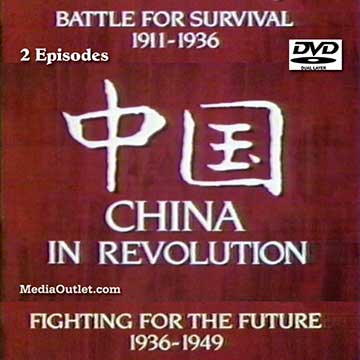
December 24, 1936: China: The History Of
China: The Century Of Humiliation (The Hundred Years Of National
Humiliation) (1838-1945): The Sino-Japanese Wars: World War II:
The Asia-Pacific War: The Second Sino-Japanese War (The War Of
Resistance Against Japanese Aggression): The Second United Front:
The Xi'an Incident (The Sian Incident): -- Coerced into submission
by kidnappers from within his own command, Chiang Kai-shek makes
official on Christmas Eve, having agreed in principle four days
earlier, to the Second United Front, a brief alliance between
Chiang's Kuomintang (KMT aka GMD) and the Chinese Communist Party
(CCP) to resist the Japanese invasion, agreeing that the GMD would
cease its efforts to restrain the communists, and to focus its
military power on fighting the Japanese. In 1936, Chiang Kai-shek
assigned the "young marshal" Zhang Xueliang the duty of
suppressing the Red Army of the CCP. Battles with the Red Army
resulted in great casualties for Zhang's forces, but Chiang
Kai-shek did not provide any support to his troops. On December 12
1936, a deeply disgruntled Zhang Xueliang kidnapped Chiang
Kai-shek in Xi'an to force an end to the conflict between KMT and
CCP. To secure the release of Chiang, the KMT was forced to agree
to a temporary end to the Chinese Civil War and the forming of a
united front between the CCP and KMT against Japan. The China
Democratic League, an umbrella organization for three political
parties and three political pressure groups, also agreed to take
part in the united front formed by KMT and the CCP. On Sale @ 15%
Off Discount Till Midnight PT!
https://store.earthstation1.com/china-in-revolution-19111949-dvd-2-part-tv-documenta191119492.html
Today's
EarthStation1.com 15% Off Commemorative Memorial Title: Props And
Jets: Catapult Planes Wright Bros, V-1, Carriers DVD MP4 USB
Today, December 24, 2025
December 24, 1942: The European Civil
War: World War II: The Second European War (The European Theater
Of World War II): The Western Front Of World War II: Science And
Technology During World War II: Science And Technology In Nazi
Germany: Research And Development In Nazi Germany (R & D In
Nazi Germany): Wunderwaffen (German: "Wonder Weapons",
"Miracle Weapons"); V-Weapons (German:
Vergeltungswaffen, "Vengeance Weapons", "Retaliatory
Weapons", "Reprisal Weapons"): The V-1 (The V-1
Flying Bomb, German: Vergeltungswaffe 1, "Vengeance Weapon
1", Fi 103, Hollenhund (German: "Hellhound") (Buzz
Bomb, Doodlebug, Kirschkern (German: Cherry Stone), Maikafer
(German: Maybug): Lentavat Torpedot (Finnish: "Flying
Torpedoes"): -- The first modern surface-to-surface guided
missile, later known as the V-1 Flying Bomb, was launched by
German rocket engineer Wernher Von Braun. Known as Buzz Bombs,
they were used by Nazi Germany against England beginning in
September 1944. The V-1 Flying Bomb (German: Vergeltungswaffe 1
"Vengeance Weapon 1", also known to the Allies as the
buzz bomb, robot bomb or doodlebug, and in Germany as Kirschkern
(cherrystone) or Maikaefer (maybug) - was an early cruise missile
and the only production aircraft to use a pulsejet for power. The
V-1 was the first of the so-called "Vengeance weapons"
series (V-weapons or Vergeltungswaffen) deployed for the terror
bombing of London. It was developed at Peenemunde Army Research
Center in 1939 by the Nazi German Luftwaffe at the beginning of
the Second World War, and during initial development was known by
the codename "Cherry Stone". Because of its limited
range, the thousands of V-1 missiles launched into England were
fired from launch facilities along the French (Pas-de-Calais) and
Dutch coasts. At peak, more than one hundred V-1s a day were fired
at south-east England, 9,521 in total, decreasing in number as
sites were overrun until October 1944, when the last V-1 site in
range of Britain was overrun by Allied forces. After this, the
Germans directed V-1s at the port of Antwerp and at other targets
in Belgium, launching a further 2,448 V-1s. The attacks stopped
only a month before the war in Europe ended, when the last launch
site in the Low Countries was overrun on 29 March 1945. As part of
operations against the V-1, the British operated an arrangement of
air defences, including anti-aircraft guns and fighter aircraft,
to intercept the bombs before they reached their targets, while
the launch sites and underground storage depots became targets for
Allied attacks including strategic bombing. On Sale @ 15% Off
Discount Till Midnight PT!
https://store.earthstation1.com/props-and-jets-catapult-planes-dvd.html
Today's
EarthStation1.com 15% Off Commemorative Memorial Title: Crusade In
Europe WWII TV Series DVD, Video Download, USB Flash Drive
Today, December 24, 2025
December 24, 1943: The European Civil
War: World War II: The Second European War (The European Theater
Of World War II): The Western Front Of World War II: The
Liberation Of France: Operation Overlord (The Battle Of Normandy,
The Normandy Campaign): -- U.S. General Dwight D. Eisenhower is
named Supreme Allied Commander of the Supreme Headquarters Allied
Expeditionary Force (SHAEF) in preparation for Operation Overlord,
the D-Day Invasion of Normandy. Supreme Allied Commander is the
title held by the most senior commander within certain
multinational military alliances. It originated as a term used by
the Allies to refer to French General Ferdinand Foch, the Supreme
Allied Commander during the First World War. During World War II,
three Allied commanders held the title: American General Of The
Army Dwight D. Eisenhower as Supreme Commander Allied
Expeditionary Force (SCAEF) in the European theatre; British
Admiral Of The Fleet Lord Louis Mountbatten as Supreme Allied
Commander South East Asia (SACSEA) throughout most of its
existence (he replaced General Archibald Wavell); Generalissimo
Chiang Kai-shek as Supreme Commander Of Allied forces In The China
War Zone (CBI) (though US forces in practice were usually overseen
by General Joseph Stilwell, the Deputy Allied Commander in China
and South East Asia Command (SEAC)); and General of the Army
Douglas MacArthur, Supreme Allied Commander, South West Pacific
Area (SWPA), though he preferred to use the title
Commander-In-Chief (during the Allied occupation of Japan
following the war, MacArthur held the title of Supreme Commander
for the Allied Powers (SCAP)). Currently, Supreme Allied Commander
is used only within NATO - for Supreme Allied Commander Europe and
Supreme Allied Commander Transformation. Supreme Headquarters
Allied Expeditionary Force (SHAEF) was the headquarters of the
Commander of Allied forces in north west Europe, from late 1943
until the end of World War II. U.S. General Dwight D. Eisenhower
was the commander in SHAEF throughout its existence. The position
itself shares a common lineage with Supreme Allied Commander
Europe and Atlantic, but they are different titles. On Sale @ 15%
Off Discount Till Midnight PT!
https://store.earthstation1.com/crusade-in-europe-2-dual-layer-dvds-tv-series-eisenhowe2.html
Today's
EarthStation1.com 15% Off Commemorative Memorial Title: The
Vietnam War With Walter Cronkite DVD, Video Download, USB Drive
Today, December 24, 2025
December 24, 1964: Vietnam War: The
Aftermath Of World War II: The Cold War: The Cold War In Asia: The
Indochina Wars: The Vietnam War (The Second Indochina War, The
Vietnam Conflict, The Resistance War Against America): The United
States In The Vietnam War: The 1964 Brinks Hotel Bombing (The 1964
Brink Bachelor Officers Quarters Bombing: -- Two Viet Cong
operatives detonated a car bomb underneath the Brinks Hotel in
Saigon, South Vietnam, also known as the Brink Bachelor Officers
Quarters (BOQ), which housed US Army officers, in the evening of
Christmas Eve. The explosion killed two Americans, an officer and
an NCO, and injured approximately 60, including military personnel
and Vietnamese civilians. The Viet Cong commanders had planned the
venture with two objectives in mind. First, by attacking an
American installation in the center of the heavily guarded
capital, the Viet Cong intended to demonstrate their ability to
strike in South Vietnam should the United States decide to launch
air raids against North Vietnam. Second, the bombing would
demonstrate to the South Vietnamese that the Americans were
vulnerable and could not be relied upon for protection. The
bombing prompted debate within the administration of United States
President Lyndon B. Johnson. Most of his advisers favored
retaliatory bombing of North Vietnam and the introduction of
American combat troops, while Johnson preferred the existing
strategy of training the Army of the Republic of Vietnam to
protect South Vietnam from the Vietcong. In the end, Johnson
decided not to take retaliatory action. On Sale @ 15% Off Discount
Till Midnight PT!
https://store.earthstation1.com/the-vietnam-war-with-walter-cronkite-tv-series-3-dvd-se3.html
Today's
EarthStation1.com 15% Off Commemorative Memorial Title: Outer
Space Films 3 Project Apollo Reaching For The Moon DVD, MP4, USB
Today, December 24, 2025
December 24, 1968: The History Of
Rocketry: The History Of Spaceflight: The Aftermath Of World War
II: The Cold War: The Space Age: The Space Race: Spaceflight
Firsts: Space Programs Of The United States: Human Spaceflight
Programs: The Discovery And Exploration Of The Solar System:
Missions To The Moon: Project Apollo: Apollo 8: -- Mission
Commander Frank Borman, Command Module Pilot James Lovell and
Lunar Module Pilot William Anders enter into orbit around the
Moon, becoming the first humans to do so. The astronauts orbited
ten times over the course of 20 hours, during which the crew made
a Christmas Eve television broadcast where they read the first 10
verses from the Book of Genesis. At the time, the broadcast was
the most watched TV program ever. On December 21, they were
launched from the Kennedy Space Center, placing its crew on a
lunar trajectory for the first visit to another celestial body by
humans. Apollo 8, the second manned spaceflight mission in the
United States Apollo space program, became the first manned
spacecraft to leave Earth orbit, reach the Earth's Moon, orbit it
and return safely to Earth. The three-astronaut crew: Borman,
Lovell, and Lunar Module Pilot William Anders: became the first
humans to: travel beyond low Earth orbit; see Earth as a whole
planet; enter the gravity well of another celestial body (Earth's
moon); orbit another celestial body (Earth's moon); directly see
the far side of the Moon with their own eyes; witness an
Earthrise; escape the gravity of another celestial body (Earth's
moon); and re-enter the gravitational well of Earth. The 1968
mission, the third flight of the Saturn V rocket and that rocket's
first crewed launch, was also the first human spaceflight launch
from the Kennedy Space Center, Florida, located adjacent to Cape
Canaveral Air Force Station. Originally planned as a second Lunar
Module/Command Module test in an elliptical medium Earth orbit in
early 1969, the mission profile was changed in August 1968 to a
more ambitious Command Module-only lunar orbital flight to be
flown in December, because the Lunar Module was not yet ready to
make its first flight. This meant Borman's crew was scheduled to
fly two to three months sooner than originally planned, leaving
them a shorter time for training and preparation, thus placing
more demands than usual on their time and discipline. Apollo 8
took three days to travel to the Moon. Apollo 8's successful
mission paved the way for Apollo 11 to fulfill U.S. President John
F. Kennedy's goal of landing a man on the Moon before the end of
the 1960s. The Apollo 8 astronauts returned to Earth on December
27, 1968, when their spacecraft splashed down in the Northern
Pacific Ocean. The crew was named Time magazine's "Men of the
Year" for 1968 upon their return. On Sale @ 15% Off Discount
Till Midnight PT!
https://store.earthstation1.com/outer-space-films-3-project-apollo-reaching-for-the-moon-dv3.html
Today's
EarthStation1.com 15% Off Commemorative Memorial Title: The
Stations Of Bach DVD, MP4 Video Download, USB Flash Drive
Today, December 24, 2025
December 24, 1968: Broadcasting: The
History Of Broadcasting: Radio Broadcasting: The History Of Radio
Broadcasting: Bachfest (Bachfest WKCR, Bachfest New York City,
Bachfest NYC): -- WKCR first broadcasts its annual Bachfest at the
stroke of midnight, continuing on through Christmas Eve day until
midnight New Year's Eve. WKCR's Bach Festival is an 8-day long
preemption of the radio station's regular programming which
features only the music and genius of Johann Sebastian Bach,
lasting from Christmas Eve (12/24) through New Year's Eve (12/31).
Our EarthStation1.com/MediaOutlet.com proprietor J. C. Kaelin
says: "On Christmas Eve 1969, I got my very first radio - an
Admiral AM/FM/AFC, that smelled of burning wax when it was on for
a while because of the heat of the radio's transistors. The first
FM station I tuned it to that night - the very first FM station I
ever tuned into - was the world's first FM station, Columbia
University's WKCR ("King's Crown Radio", as the station
ID intoned). They were less than 24 hours into their second annual
Bachfest (making it the first night it had become an annual event)
and it was there that I heard a pipe organ for the first time. I
thought it was strange and wonderful, unlike anything I had ever
heard my father play on the car radio before (and he played that
radio a lot!). I was quite enchanted, and truly, I've never been
the same since - in the best possible way." So tune in to
WKCR-FM NY 89.9 or stream them at wkcr.org and listen to a
straight 192 hours of Bach and share in the celebration of another
year's end! On Sale @ 15% Off Discount Till Midnight PT!
https://store.earthstation1.com/the-stations-of-bach-dvd-johann-sebastion-bach-documentary.html
Today's
EarthStation1.com 15% Off Commemorative Memorial Title: Witnesses:
What Happened In Soviet-Afghan War MP4 Video Download DVD
Today, December 24, 2025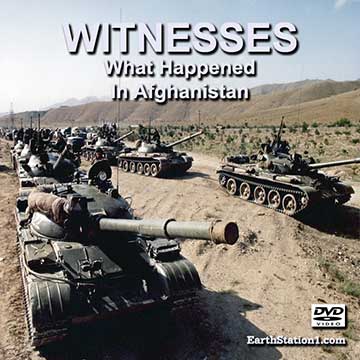
December 24, 1979: The Aftermath Of World
War II: The Cold War: The Afghan Conflict (The Afghan Crisis, The
Instability In Afghanistan): The Soviet-Afghan War: The Soviet
Invasion Of Afghanistan: -- The Soviet defence ministry, under
leader Leonid Brezhnev, sends armoured columns of the Soviet 40th
Army across the Russian-Afghan border into Afghanistan at Termez
and Kushka, headed towards the Afghan cities of Kabul and Herat
respectively, marking the start of the Soviet-Afghan War. Arriving
in the Afghan capital of Kabul, they sent commandos to seize
strategic installations, then they staged a coup (Operation
Storm-333; Russian: Shtorm-333) that killed Afghan General
Secretary Amin and installed Soviet loyalist Babrak Karmal from
the rival faction Parcham. The deployment had been variously
called either an "invasion" by Western media and the
Mujahideen rebels, or a legitimate supporting intervention, on the
basis of the Brezhnev Doctrine (a Soviet foreign policy that
proclaimed any threat to socialist rule in any state of the Soviet
bloc in Central and Eastern Europe was a threat to them all, and
therefore justified the intervention of fellow socialist states)
by the Soviet Union and the Afghan government of the Parchamite
faction of the People's Democratic Party of Afghanistan. The
causes of the conflict are found in the Saur Revolution, a 1978
coup wherein Afghanistan's communist party took power, initiating
a series of radical modernization and land reforms throughout the
country. These reforms were deeply unpopular among the more
traditional rural population and established power structures. The
repressive nature of the "Democratic Republic", which
vigorously suppressed opposition and executed thousands of
political prisoners, led to the rise of anti-government armed
groups; by April 1979, large parts of the country were in open
rebellion. The communist party itself experienced deep internal
rivalries between the Khalqists and Parchamites; in September
1979, People's Democratic Party General Secretary Nur Mohammad
Taraki was assassinated under orders of the second-in-command,
Hafizullah Amin, an act which soured relations with the Soviet
Union and lead to the Soviet invasion. The Soviet-Afghan War
ultimately became a conflict wherein insurgent groups (known
collectively as the Mujahideen), as well as smaller Maoist groups,
fought a nine-year guerrilla war against the Soviet Army and the
Democratic Republic of Afghanistan government throughout the
1980s, mostly in the Afghan countryside. The Mujahideen were
variously backed primarily by the United States, Pakistan, Iran,
Saudi Arabia, China, and the United Kingdom; the conflict was a
Cold War-era proxy war. Between 562,000 and 2,000,000 civilians
were killed and millions of Afghans fled the country as refugees,
mostly to Pakistan and Iran. The war caused grave destruction in
Afghanistan and contributed to the Soviet collapse, in hindsight
leaving a mixed and tragic legacy to the peoples of both
territories. The song "Bombs Away" by the Police, penned
by their drummer Stewart Copeland for their "Zenyatta
Mondatta" studio album, is about this invasion. On Sale @ 15%
Off Discount Till Midnight PT!
https://store.earthstation1.com/witnesses-what-happened-in-sovietafghan-war-mp4-video-download-dv4.html
Today's
EarthStation1.com 15% Off Commemorative Memorial Title: Best UFO
Cases: Rendlesham Belgium Falcon Lake Lake Michigan MP4 DVD
Today, December 24, 2025
December 24, 1980: Unidentified Flying Objects (UFOs, Unidentified Anomalous Phenomenon, UAPs): UFO Incidents (Unidentified Flying Object Incidents): he Rendlesham Forest Incident: -- Highly qualitied witnesses report the first of several sightings of unexplained lights near RAF Woodbridge, in Rendlesham Forest, Suffolk, England, United Kingdom during late December of 1980, an incident called "Britain's Roswell". RAF Woodbridge was used at the time by the U.S. Air Force, who maintained an atomic air wing there as well as the nuclear weapons they carried. USAF personnel, including deputy base commander Lieutenant Colonel Charles I Halt claimed to see things they described as a UFO sighting. During the late hours of December 27 and early December 28, Halt maintained radio communications between himself, others involved in the incident and the base. Audio recordings of these communications have been made public. At one point, a pencil-thin beam of light was shot from an object hovering over Halt's head into an area just in front of his feet. The occurrence is the most famous of UFO events to have happened in the United Kingdom, ranking among the best-known reported UFO events worldwide. On Sale @ 15% Off Discount Till Midnight PT! https://store.earthstation1.com/beufocarebef.html
Today's
EarthStation1.com 15% Off Commemorative Memorial Title: High
Crimes And Misdemeanors: The Iran-Contra Scandal DVD, MP4, USB
Today, December 24, 2025
December 24, 1992: Scandals: Political
Scandals: Political Scandals Of The United States: The Aftermath
Of World War II: The Cold War: The Cold War (1979-1985): The
Iran-Iraq War: Iran-United States Relations: The Iran-Contra
Affair (The Iran-Contra Scandal): -- President George W. Bush, a
lame duck president after being defeated for reelection, issues
Christmas Eve pardons to five administration officials who had
been found guilty on charges relating to the Iran-Contra Scandal
during the administration of his presidential predecessor Ronald
Reagan: Caspar Weinberger, Robert C. McFarlane, Elliott Abrams,
Alan D. Fiers, Clair George and Duane Clarridge. Attorney General
William P. Barr advised the President on these pardons, especially
that of Caspar Weinberger. In response to these Bush pardons,
Independent Counsel Lawrence E. Walsh, who headed the
investigation of Reagan Administration officials' criminal conduct
in the Iran-Contra scandal, stated that "the Iran-Contra
cover-up, which has continued for more than six years, has now
been completed." Walsh noted that in issuing the pardons Bush
appears to have been preempting being implicated himself in the
crimes of Iran-Contra by evidence that was to come to light during
the Weinberger trial, and noted that there was a pattern of
"deception and obstruction" by Bush, Weinberger and
other senior Reagan administration officials. On Sale @ 15% Off
Discount Till Midnight PT!
https://store.earthstation1.com/high-crimes-and-misdemeanors-the-ironcontra-scandal-dvd.html
Today's
EarthStation1.com #OnThisDay Commemorative Memorial Title: Pope
Pius XII Documentary Eugenio Pacelli Biography DVD, Download, USB
Today, December 24, 2025 December 24, 1939: The European Civil
War: World War II: The Second European War (The European Theater
Of World War II): Anti-Fascism: German Resistance To Nazism: Pope
Pius XII: Pope Pius XII And World War II: Vatican Radio (Italian:
Radio Vaticana; Latin: Statio Radiophonica Vaticana): Pope Pius
XII's 1939 Christmas Address: -- Pope Pius XII makes a Christmas
Eve appeal for peace and lays down five principles essential for a
just and lasting peace: 1) practical and spiritual disarmament; 2)
the recognition of minority rights; 3) the right to life; 4) the
right of every nation to independence, and 5) the creation of more
effective international institutions to defend and promote peace.
Although he was convinced that Communism was even more dangerous
than Nazism, he did not endorse Hitler's attack on Russia.
Throughout the war he supervised, through the Pontifical Aid
Commission, a vast programme for the relief of war victims,
especially prisoners of war; and when Hitler occupied Rome on
September 10, 1943 Pius XII made the Vatican City an asylum for
countless refugees, including numerous Jews.
https://store.earthstation1.com/pope-pius-xii-dvd-cardinal-secretary-of-state-eugenio-pacelli1.html
December 24, 1939: The European Civil
War: World War II: The Second European War (The European Theater
Of World War II): Anti-Fascism: German Resistance To Nazism: Pope
Pius XII: Pope Pius XII And World War II: Vatican Radio (Italian:
Radio Vaticana; Latin: Statio Radiophonica Vaticana): Pope Pius
XII's 1939 Christmas Address: -- Pope Pius XII makes a Christmas
Eve appeal for peace and lays down five principles essential for a
just and lasting peace: 1) practical and spiritual disarmament; 2)
the recognition of minority rights; 3) the right to life; 4) the
right of every nation to independence, and 5) the creation of more
effective international institutions to defend and promote peace.
Although he was convinced that Communism was even more dangerous
than Nazism, he did not endorse Hitler's attack on Russia.
Throughout the war he supervised, through the Pontifical Aid
Commission, a vast programme for the relief of war victims,
especially prisoners of war; and when Hitler occupied Rome on
September 10, 1943 Pius XII made the Vatican City an asylum for
countless refugees, including numerous Jews.
https://store.earthstation1.com/pope-pius-xii-dvd-cardinal-secretary-of-state-eugenio-pacelli1.html
Today's
EarthStation1.com #OnThisDay Commemorative Memorial Title: TV
Music & Dance Shows #9 The Action Is Here DVD, MP4, USB Flash
Drive
Today, December 24, 2025December 24, 1924: #BOTD: #HBD! Lee
Dorsey, African American American pop, R & B, soul and funk
singer, songwriter (d. 1986) is #born Irving Lee Dorsey in New
Orleans, Louisiana, Dorsey was a childhood friend of Fats Domino
before moving to Portland, Oregon when he was ten years old. His
biggest hits were "Ya Ya" (1961) and "Working in
the Coal Mine" (1966). Much of his work was produced by Allen
Toussaint, with instrumental backing provided by The Meters. Lee
Dorsey died of emphysema in New Orleans, Louisiana at the age of
61. He is buried at Restlawn Park Cemetery And Mausoleum in
Waggaman, Jefferson Parish, Louisiana.
https://store.earthstation1.com/classic-tv-music-amp-dance-shows-9-the-action-is-here-dv9.html
Today's
EarthStation1.com #OnThisDay Commemorative Memorial Title: TV
Music & Dance Shows #8 American Action DVD, MP4, USB Flash
Drive
Today, December 24, 2025December 24, 2000: #DOTD: #RIP: Nick
Massi, American bass singer, songwriter, and bass guitarist for
The Four Seasons (b. September 19, 1927) #dies of cancer at his
home in West Orange, New Jersey. He is buried in Graceland
Memorial Park cemetary in Kenilworth, New Jersey. Nick Massi was
born Nicholas E. Macioci in Newark, New Jersey. Born, Nicholas
"Massi" Macioci first learned to play the bass fiddle by
Newark native and musician, Anthony Gaeta. As a bass singer, Massi
had been playing with several bands before he joined The Four
Lovers in 1958, including some groups that featured future Four
Lovers and Four Seasons members Frankie Valli and Tommy DeVito.
After the group evolved into the Four Seasons, he was responsible
for most of the group's vocal arrangements. While a member of The
Four Seasons, Massi's vocal arrangements helped result in the
number-one hits "Sherry" (1962), "Big Girls Don't
Cry" (1962), "Walk Like a Man" and (1963), "Rag
Doll"; "Dawn" (1964) remained at #3 for three
weeks, then dropped to make way for two further Beatles singles
("Twist and Shout" and "Please Please Me");
during its six-week run in the Top Ten (only Beatles hits ranked
above it in the charts). Massi left the Four Seasons in September
1965, and was replaced temporarily by Charles Calello who, in
turn, was replaced by Joe Long. Massi, Tommy DeVito, Frankie
Valli, and Bob Gaudio - the original members of The Four Seasons -
were inducted into The Rock And Roll Hall Of Fame in 1990 and the
Vocal Group Hall of Fame in 1999.
https://store.earthstation1.com/classic-tv-music-amp-dance-shows-8-where-american-action-is-dv8.html
Today's
EarthStation1.com #OnThisDay Commemorative Memorial Title: Frank
Zappa Documentaries MP4 Video Download DVD
Today, December 24, 2025December 24, 2012: #DOTD: #RIP: Ray
Collins, American singer, guitarist and harmonica player, best
known as a member of The Mothers Of Invention (b. November 19,
1936) #dies of a heart attack sustained days earlier in Claremont,
California at age 76. His remains were cremated; the final
disposition of his cremains is unknown. Ray Collins grew up in
Pomona, California singing in his school choir, the son of a local
police officer. He quit high school to get married. Collins
started his musical career singing falsetto backup vocals for
various doo-wop groups in the Los Angeles area in the late 1950s
and early 1960s, including Little Julian Herrera and the Tigers.
In 1964, Collins, drummer Jimmy Carl Black, bassist Roy Estrada,
saxophonist Dave Coronado, and guitarist Ray Hunt formed The Soul
Giants. Hunt was eventually replaced by Frank Zappa, and the group
evolved into the Mothers of Invention. Ray was the lead vocalist
on most songs for their early albums, including Freak Out!,
Absolutely Free, Cruising with Ruben & the Jets and Uncle
Meat. He additionally provided harmonica on Freak Out!. In 1968
Ray quit The Mothers of Invention and was replaced by Lowell
George, but continued to contribute to other Zappa projects
through the mid-1970s. Currently Ray Collins niece/protege Shay
Collins has been leading her own mission to carry on the name and
memory of Ray Collins, with an American rock duo Mother Legacy.
Labeling herself as Ray's legacy, determined to carry on all of
his teachings and steadfast beliefs and desires in music. Collins
resided in Claremont, California in a back yard van until his
death.
https://store.earthstation1.com/frank-zappa-documentaries-mp4-video-download-dv4.html
Today's
EarthStation1.com #OnThisDay Commemorative Memorial Title: Rock &
Roll An Unruly History 10 Part TV Series MP4 Video Download DVD
Today, December 24, 2025December 24, 1955: #BOTD: #HBD! Gary
Valentine, American writer and musician who came to prominence in
the mid-1970s as the bass guitarist for rock band Blondie, is
#born Gary Joseph Lachman in Bayonne, New Jersey. Since the 1990s,
Lachman has written full-time, often about mysticism and
occultism.
https://store.earthstation1.com/rock-amp-roll-an-unruly-history-10-part-tv-series-mp4-video-download-104.html
Today's
EarthStation1.com #OnThisDay Commemorative Memorial Title: X Minus
One: Sci-Fi Radio Series MP3 DVD, Download, USB Flash Drive
Today, December 24, 2025December 24, 1910: #BOTD: #HBD! Fritz
Leiber, American writer of fantasy, horror, and science fiction,
poet, actor in theater and films, playwright, and chess expert (d.
September 5, 1992) is #born Fritz Reuter Leiber Jr. on Christmas
Eve, 1910, in Chicago, Illinois, to the Shakespearean actors Fritz
Leiber and Virginia Bronson Leiber. Along with writers such as
Robert E. Howard and Michael Moorcock, Fritz Leiber is one of the
fathers of Sword And Sorcery (S & S, Heroic Fantasy), a
subgenre of fantasy characterized by sword-wielding heroes engaged
in exciting and violent adventures, and coined the term. Fritz
Leiber died aged 81 of a stroke a few weeks after a physical
collapse while traveling from a science fiction convention in
London, Ontario, Canada with his second wife, Margo Skinner. His
burial details are not publicly disclosed, other than that he is
buried somewhere in California.
https://store.earthstation1.com/x-minus-one-mp3-dvd-complete-radio-serie3.html
Today's
EarthStation1.com #OnThisDay Commemorative Memorial Title: Akira
Kurosawa (1979) Film Director Documentary DVD, Download, USB
Today, December 24, 2025December 24, 1997: #DOTD: #RIP: Toshiro
Mifune, Japanese actor and producer, widely considered one of the
greatest actors of all time, winner of numerous awards and
accolades over a lengthy career, best known for starring in Akira
Kurosawa's critically-acclaimed jidaigeki films (period dramas
that take place before the Meiji Restoration) such as Rashomon
(1950), Seven Samurai (1954), Throne of Blood (1957), The Hidden
Fortress (1958) and Yojimbo (1961), as Miyamoto Musashi in Hiroshi
Inagaki's Samurai Trilogy (1954-1956), Lord Toranaga in the NBC
television miniseries Shogun, and Admiral Isoroku Yamamoto in
three different films [Admiral Yamamoto (1968), The Militarists
(1970) and Midway (1976) (b. April 1, 1920) #dies in Mitaka,
Tokyo, Japan of multiple organ failure at the age of 77. He is
buried at the Mifune family tomb in Kawasaki, Kanagawa, Japan.
Toshiro Mifune was born Mifune Toshiro in Seito, Japanese-occupied
Shandong (present-day Qingdao, China), the eldest son of Tokuzo
Mifune, a trade merchant and photographer who ran a photography
business in Qingdao and Yingkou, and Sen Mifune, the daughter of a
hatamoto, a high-ranking samurai official; both of his parents
were working as Methodist missionaries, and were among the
Japanese citizens encouraged to live in Shandong by the Japanese
government during its occupation of China, before the Republic Of
China took over the city in 1922. After spending the first 19
years of his life in China as a Japanese citizen, he was drafted
into the Imperial Japanese Army Aviation division, where he served
in the Aerial Photography unit during World War II. In 1947, a
large number of Toho actors, after a prolonged strike, had left to
form their own company, Shin Toho. Toho then organized a "new
faces" contest to find new talent. Nenji Oyama, a friend of
Mifune's who worked for the Photography Department of Toho
Productions, sent Mifune's resume to the New Faces audition as the
Photography Department was full, telling Mifune he could later
transfer to the Photography Department if he wished. He was
accepted, along with 48 others (out of roughly 4,000 applicants),
and allowed to take a screen test for Kajiro Yamamoto. Instructed
to mime anger, he drew from his wartime experiences. Yamamoto took
a liking to Mifune, recommending him to director Senkichi
Taniguchi. This led to Mifune's first feature role, in Shin Baka
Jidai. Mifune first encountered director Akira Kurosawa when Toho
Studios, the largest film production company in Japan, was
conducting a massive talent search, during which hundreds of
aspiring actors auditioned before a team of judges. Kurosawa was
originally going to skip the event, but showed up when Hideko
Takamine told him of one actor who seemed especially promising.
Kurosawa later wrote that he entered the audition to see "a
young man reeling around the room in a violent frenzy... it was as
frightening as watching a wounded beast trying to break loose. I
was transfixed." When Mifune, exhausted, finished his scene,
he sat down and gave the judges an ominous stare. He lost the
competition but Kurosawa was impressed. "I am a person rarely
impressed by actors," he later said. "But in the case of
Mifune I was completely overwhelmed." Mifune immersed himself
into the six-month training and diligently applied himself to
studying acting, although at first he still hoped to be
transferred to the camera department. His imposing bearing, acting
range, facility with foreign languages and lengthy partnership
with acclaimed director Akira Kurosawa made him the most famous
Japanese actor of his time, and easily the best known to Western
audiences. He often portrayed samurai or ronin who were usually
coarse and gruff (Kurosawa once explained that the only weakness
he could find with Mifune and his acting ability was his "rough"
voice), inverting the popular stereotype of the genteel, clean-cut
samurai. In Kurosawa's Something Like an Autobiography (1981), he
wrote: "Mifune had a kind of talent I had never encountered
before in the Japanese film world. It was, above all, the speed
with which he expressed himself that was astounding. The ordinary
Japanese actor might need ten feet of film to get across an
impression; Mifune needed only three. The speed of his movements
was such that he said in a single action what took ordinary actors
three separate movements to express. He put forth everything
directly and boldly, and his sense of timing was the keenest I had
ever seen in a Japanese actor. And yet with all his quickness, he
also had surprisingly fine sensibilities." Of Akira Kurosawa,
Toshiro Mifune said, "I have never as an actor done anything
that I am proud of other than with him". Of his acting
career, Mifune said "Since I came into the industry very
inexperienced, I don't have any theory of acting. I just had to
play my roles my way", and "Generally speaking, most
East-West stories have been a series of cliches. I, for one, have
no desire to retell Madame Butterfly". Mifune won the Volpi
Cup for Best Actor twice, in 1961 and 1965. He was awarded the
Medal of Honor with Purple Ribbon in 1986 and the Order of the
Sacred Treasure in 1993. In 1973, he was a member of the jury at
the 8th Moscow International Film Festival. In 1977, he was a
member of the jury at the 10th Moscow International Film Festival.
On November 14, 2016, nineteen years after he died, Mifune
received a star on the Hollywood Walk of Fame for his work in the
motion picture industry.
https://store.earthstation1.com/akira-kurosawa-film-director-dvd.html
Today's
EarthStation1.com #OnThisDay Commemorative Memorial Title: The
Unknown War: The Great Patriotic War Series WWII USSR DVD MP4 USB
Today, December 24, 2025December 24, 1944: The European Civil
War: World War II: The Second European War (The European Theater
Of World War II): The Eastern Front Of World War II: The Great
Patriotic War (The German-Soviet War): The Budapest Offensive: The
Siege Of Budapest (The Battle Of Budapest): -- The Siege Of
Budapest begins when Budapest, defended by Hungarian and German
troops, was first encircled on December 26, 1944 by the Red Army
and the Romanian Army. The Siege Of Budapest was the 50 day
encirclement by Soviet forces of the Hungarian capital of
Budapest. Part of the broader Budapest Offensive, the siege
concluded on February 13, 1945 with the Red Army winning the
unconditional surrender of German and Hungarian forces. During the
siege, about 38,000 civilians died through starvation or military
action. The city unconditionally surrendered on February 13, 1945.
It was a strategic victory for the Allies in their push towards
Berlin.
https://store.earthstation1.com/the-unknown-war-complete-tv-series-soviet-union-wwii-10-dvd-s10.html
Today's
EarthStation1.com #OnThisDay Commemorative Memorial Title: The
Assassination Of Abraham Lincoln MP4 Video Download DVD
Today, December 24, 2025December 24, 1869: #DOTD: Edwin Stanton,
American lawyer and politician who served as U.S. secretary of war
under the Lincoln Administration during most of the American Civil
War, conspirator and likely mastermind in the assassination of
Abraham Lincoln (b. December 19, 1814) #dies in the evening of an
acute asthma attack at his home in Washington, D.C., having
suffered in his final years of a complex of illnesses, aged 55.
His buried next to his son James Hutchinson Stanton in Washington
D.C.'s Oak Hill Cemetery. Edwin Stanton was born Edwin McMasters
Stanton in Steubenville, Ohio. Stanton's management helped
organize the massive military resources of the North and guide the
Union to victory. However, he was criticized by many Union
generals, who perceived him as overcautious and a micromanager. He
also "organized" the manhunt for Abraham Lincoln's
assassin, John Wilkes Booth. After Lincoln's assassination,
Stanton remained as the secretary of war under the new U.S.
president, Andrew Johnson, during the first years of
Reconstruction. He opposed the lenient policies of Johnson towards
the former Confederate States. Johnson's attempt to dismiss
Stanton ultimately led to Johnson being impeached by the Radical
Republicans in the House of Representatives. Stanton returned to
law after he retired as secretary of war. In 1869, he was
nominated as an associate justice of the Supreme Court by
Johnson's successor, Ulysses S. Grant, but Stanton died four days
after his nomination was confirmed by the Senate. He remains the
only confirmed nominee to accept but die before serving on the
Court. In the 1930s, a book written by Otto Eisenschiml accused
Stanton of arranging the assassination of Lincoln. Eisenschim's
book inspired considerable debate and the 1977 book and movie, The
Lincoln Conspiracy, and the 1971 TV movie/re-enactment, They've
Killed President Lincoln!, narrated by Richard Basehart.
https://store.earthstation1.com/the-assassination-of-abraham-lincoln-mp4-video-download-dvd.html
Today's
EarthStation1.com #OnThisDay Commemorative Memorial Title: Edward
R. Murrow: This Reporter TV Series DVD, Download, USB Drive
Today, December 24, 2025December 24, 2006: #DOTD: Frank Stanton,
American broadcasting executive, President of The Columbia
Broadcasting System (CBS) between 1946 and 1971, Vice Chairman of
CBS until 1973, Chairman of the Rand Corporation from 1961 until
1967, administrator-designate of the Emergency Communications
Agency, part of the secret group (The Eisenhower Ten) created by
President Eisenhower in 1958 to serve in the event of a national
emergency (b. March 20, 1908) #dies in his sleep at his home in
Boston at the age of 98. His burial details are not publicly
disclosed. Frank Stanton was born Frank Nicholas Stanton in in
Muskegon, Michigan. During the period of McCarthyism, Stanton
created an office at CBS to review the political leanings of
employees. At Stanton's direction, employees were required to take
an oath of loyalty to the US government, and blacklisting became
policy. Good Night, and Good Luck, a 2005 movie portraying this
era as it took shape during the famous showdown between Edward R.
Murrow and Joseph McCarthy, left Stanton out of the film as a
character, partly because Stanton was still living and might have
objected to his portrayal. Stanton played a role in the infamous
controversy involving Arthur Godfrey's firing of Julius LaRosa.
LaRosa hired a manager following a minor dispute with Godfrey.
Godfrey consulted Stanton, who suggested that he fire the popular
LaRosa, then a rising star, on the air - just as he'd hired him on
the air in 1951. Godfrey did so on October 19, 1953, without
informing LaRosa before the airing, announcing "that was
Julie's swan song with us.". The move caused an enormous
backlash against Godfrey. Godfrey subsequently explained that La
Rosa had been fired because he lacked "humility." This
comment backfired badly on Godfrey; comedians began working the
phrase "no humility" into their routines. Stanton later
told Godfrey biographer Arthur Singer that "Maybe (the
recommendation) was a mistake.".
https://store.earthstation1.com/edward-r-murrow-this-reporter-dvd-2-part-tv-serie2.html
Today's
EarthStation1.com #OnThisDay Commemorative Memorial Title: World
War II: The War Years 17 Part TV Series MP4 Video Download DVD
Today, December 24, 2025December 24, 1942: #DOTD: Francois
Darlan, French Admiral Of The Fleet, Commander In Chief Of The
French Navy in 1939 at the beginning of World War II, Vichy
officer, 122nd Prime Minister Of France (b. August 7, 1881) #dies
when he is assassinated in Algiers, Algeria by Fernand Bonnier de
La Chapelle, a 20 year old monarchist opposed to the French Vichy
government who belonged to a royalist group that wanted to restore
the pretender Henri, Count Of Paris, to the throne of France.
Bonnier de La Chapelle shot Darlan twice, once in the face and
once in the chest, and was arrested immediately, tried and
convicted the next day, and executed by firing squad on December
26. Francois Darlan was born Jean Louis Xavier Francois Darlan in
Nerac, Lot-et-Garonne, to a family with a long connection with the
French Navy. His great-grandfather was killed at the Battle of
Trafalgar. His father, Jean-Baptiste Darlan, was a lawyer and
politician who served as Minister of Justice in the cabinet of
Jules Meline. Georges Leygues, a political colleague of his father
who would spend seven years as Minister of the Marine, was
Darlan's godfather. Darlan graduated from the Ecole Navale in
1902. During World War I, he commanded an artillery battery that
took part in the Battle of Verdun. After the war Darlan commanded
the training ships Jeanne d'Arc and Edgar Quinet, receiving
promotions to frigate captain in 1920 and captain in 1926.
Thereafter Darlan rose swiftly. He was appointed Chef de Cabinet
to Leygues and promoted to contre-amiral in 1929. In 1930, he
served as the French Navy's representative at the London Naval
Conference, and in 1932 he was promoted to vice-amiral.
Subsequently, in 1934, he took command of the Atlantic Squadron at
Brest. He was promoted to vice-amiral d'escadre in 1936. In 1936,
he went to London on an unsuccessful mission to persuade the
Admiralty that greater Anglo-French naval co-operation was needed
given the way that Germany and Italy had aligned as a result of
the Spanish Civil War. On 5 August 1936, Darlan met with the First
Sea Lord, Admiral Ernle Chatfield, where he expressed much concern
about the prospect of Italy obtaining naval and air bases in the
Balearic Islands and likewise Germany obtaining naval and air
bases in the Canary Islands. Darlan argued for joint Anglo-French
action to prevent the Axis powers from obtaining any bases on
Spanish soil. During the Spanish Civil War, the Front populaire
government of Leon Blum had pursued a pro-Republican neutrality
while Italy had intervened on the side of the Spanish
Nationalists, leading to acute Italo-French tensions. Blum stated
that Darlan "thinks exactly as I do" about a potential
Italian naval threat to France, and selected him as the next chief
of staff of the Marine to replace the pro-Italian Admiral Georges
Durand-Viel. In addition, Darlan was considered by Blum to be
loyal to the republic and Darlan had spoken in favour of the Front
populaire social reforms. Darlan had attracted attention within
the Marine in the fall of 1936 with his advocacy of France's
seizing the Balearic Islands to put a stop to the Italian naval
and air bases under construction there as he argued that the
prospect of Italian naval and air attacks from the Balearics on
French shipping was an intolerable threat. Through Blum did not
take up Darlan's suggestion, he did approve of him as an admiral
with strong anti-Italian views, which he considered to be a
refreshing contrast to Durand-Viel who advocated a Franco-Italian
alliance. Blum's decision in October 1936 to appoint Darlan as the
next chief of the naval staff over a number of admirals who had
more seniority and combat experience was controversial. He was
appointed Chief of the Naval Staff from 1 January 1937, at the
same time promoted to amiral. Darlan was close to Blum and the
Defence Minister Edouard Daladier. As head of the Navy he
successfully used his political connections to lobby for a
building programme to counter the rising threat from the
Kriegsmarine and Regia Marina. The American historian Reynolds
Salerno wrote: "While Durand-Viel was a soft-spoken, cautious
administrator who sought out advice from his subordinates and
deferred to his minister for major policy decisions, Darlan was an
extremely self-confident, resolute admiral who monopolized every
aspect of the Marine". Salerno described Darlan as a
conservative French nationalist who was committed to preserving
France as a great power via a programme of building more warships
for the Marine. Darlan's political views were inclined towards the
right, but he worked well with the centrist Daladier and the
leftish Blum. After attending the Coronation of George VI, Darlan
complained that protocol had left him, as a mere vice admiral,
"behind a pillar and after the Chinese admiral". In 1939
he was promoted to Amiral de la flotte, a rank created
specifically to put him on equal terms with the First Sea Lord of
the Royal Navy. Darlan saw the Regia Marina as the principal
threat to France, and pushed hard for a naval expansion intended
to make France the dominant power in the Mediterranean Sea.
Germany had a population of 70 million while France had a
population of 40 million; the numerical superiority of the Reich
made it essential that the French transport a massive number of
soldiers recruited in Algeria, Morocco and Tunisia to France to
allow the French Army to face the Wehrmacht on equal terms, and so
it was considered essential that France have command of the
sea-lanes in the western Mediterranean. Darlan argued that the
pro-German orientation of Italian foreign policy made it likely
that Italy would enter another world war on the side of Germany
and that France needed a strong Mediterranean fleet to defend the
sea-lanes linking Algeria to France in order to win against
Germany. French decision-makers believed that, given the numerical
superiority of Germany at that time, then just as in the last
world war, France would need a massive number of troops from the
Maghreb in order to have a chance of victory, and without soldiers
from the Maghreb France was doomed. In addition, Darlan argued: "A
significant part of the British and French supplies and in
particular, almost all the oil extracted from the French, British
and Russian oil fields in the East depend upon mastery of the
Mediterranean. But above all, the Mediterranean constitutes the
only communication line with our Central European allies by which
materiel may reach them". In contrast to Darlan, General
Maurice Gamelin had argued for a rapprochement with Italy as he
reasoned that a naval arms race would take away francs from the
French Army. Blum and Daladier chose the course advocated by
Darlan and in December 1936 approved of a naval construction
programme designed to make the French Mediterranean fleet the
dominant fleet in the western Mediterranean. In September 1938
during the Sudetenland crisis, Darlan mobilised the French Navy
and placed the Marine on the highest state of alert. Expecting
Italy to enter any war on the Axis side, Darlan reinforced the
French Mediterranean fleet. In the autumn of 1938 and the winter
of 1939, Darlan continued to argue for a Mediterranean strategy,
as he stated that France was secure behind the Maginot Line and
should in the event of war go on the offensive against Italy in
order to secure command of the sea in the Mediterranean. In
particular, Daladier who was now serving as prime minister, was
greatly impressed with Darlan's Mediterranean strategy. On 30
November 1938, demonstrations were organised by the Fascist regime
in Italy demanding that France cede Nice, Corsica and Tunisia to
Italy, which brought France and Italy to the brink of war. The
acute crisis in Franco-Italian relations in the winter of
1938-1939 served to reinforce Darlan's arguments within the French
government for an offensive strategy against Italy. At a meeting
of the defence chiefs in January 1939, Darlan stated that, in the
event of a war, the Marine should sever the sea-lanes linking
Italy to its colony of Libya while French warships should bombard
Naples, La Spezia, and Pantelleria. Darlan also called for the
French to seize the Italian colony of the Dodecanese islands, to
be used for a bombing campaign against Italian cities and for
invasions from Tunisia into Libya and France into Italy itself.
During the Danzig crisis, Darlan went to London on 8 August 1939
to meet the First Sea Lord, Admiral Dudley Pound, to discuss plans
should the crisis end in a war. It was agreed at the Darlan-Pound
meeting that the French fleet should remain focused on the
Mediterranean with the majority of the French fleet to be
stationed at the naval bases at Toulon, Mers-El-Kebir and Bizerte
with only one squadron to be based at Brest on France's Atlantic
coast as the Royal Navy was to take responsibility for the rest of
the North Atlantic and the North Sea. Germany and Italy had signed
an offensive-defensive alliance known as the Pact of Steel on 22
May 1939, and it was taken for granted in both London and Paris
that, should the crisis result in war, that it was inevitable that
Italy would enter the war on Germany's side at some point; hence
Darlan's focus on the Mediterranean during the Danzig crisis.
After France's declaration of war in September 1939, Darlan became
Commander-in-Chief of the French Navy. He was opposed to
Daladier's plans for a revived Salonika front. At a meeting of the
Anglo-French Supreme War Council on 22 September 1939, Darlan
sided with the British in opposing Daladier's plans to take the
Armee du Levant from Beirut to Thessaloniki with the aim of
opening a second front in the Balkans as a way to aid Poland.
Darlan argued that the plans for a new Salonika Front would
distract from the blockade of Germany. Initially, Darlan had
supported the British who believed that a naval blockade along
with strategical bombing would be sufficient to defeat the Reich
without any major land battles. The British Prime Minister,
Neville Chamberlain, believed that a combination of blockade and
strategic bombing would induce the Wehrmacht generals to overthrow
Hitler and thus bring the war to a close with no major land
battles involving British troops. At the meetings of the Supreme
War Council, Darlan along with Maurice Gamelin supported the
objections of the British against the proposed expedition to the
Balkans championed by Daladier and Maxime Weygand.] By late 1939,
Darlan complained that the blockade had too many loopholes for
neutral ships carrying war material to Germany and that the Allies
needed a more aggressive approach. In particular, Darlan noted
that, because of the Molotov-Ribbentrop pact, Germany had access
to all of the vast natural resources of the Soviet Union, which
rendered the Anglo-French naval blockade rather ineffectual. The
Soviet Union was self-sufficient in virtually all of the natural
resources needed to sustain a modern industrial economy, and
German-Soviet trade defeated the purposes of the naval blockade.
Starting in December 1939, Darlan started to advocate an
Anglo-French expedition to Scandinavia to seize the Swedish iron
mines that supplied the Germany with the high-grade iron that was
used to make steel (the Reich had no high-grade iron mines of it
own). Darlan argued that it was imperative to strike before
Germany and the Soviet Union signed another economic agreement
that would allow Germany to have access to Soviet iron, saying the
time to deprive Germany of its access to Swedish iron was now.
Darlan was one of the main advocates of a Scandinavian expedition,
arguing that seizing the Swedish iron mines would cause the
collapse of the German economy no later than the spring of 1941.
By January 1940, Darlan had convinced Daladier that the expedition
to Scandinavia would win the war for the Allies. In January 1940,
Darlan called for a joint Army-Navy expedition to sail via the
Arctic Ocean to seize the Petsamo province of Finland recently
occupied by the Red Army, even though it would almost certainly
mean war with the Soviet Union, in the hope of provoking a German
response which would allow French forces to occupy northern Sweden
and hence deprive the Reich of its most important source of iron.
Darlan had a blase attitude towards the prospect of a war with the
Soviet Union, arguing that the Molotov-Ribbentrop pact meant it
made little difference if France were at war with the Soviet Union
or not. The plans for a Scandinavian expedition drew strong
opposition from Maurice Gamelin who argued that best place for
French manpower was in defending France from the expected German
invasion. However, Gamelin's inability to produce a convincing
alternative strategy led Daladier to decide in favour of Darlan's
recommendation. Unlike the plans for a new Salonika front, the
British leaders, especially the then-First Lord of the Admiralty,
Winston Churchill, were keen on an expedition to Scandinavia.
Likewise, Darlan supported what the French called the "Baku
project" of having Anglo-French bombers based in Syria and
Iraq bomb the oil fields in Baku in Soviet Azerbaijan as a way to
cut Germany off from Soviet oil. Darlan also supported plans for
French submarines to be sent into the Black Sea to sink Soviet oil
tankers. Darlan was immensely proud of the French navy which he
had helped to build up, and after Axis forces defeated France
(May-June 1940), on 3 June he threatened that he would mutiny and
lead the fleet to fight under the British flag in the event of an
armistice. Darlan promised Churchill, now the British prime
minister, at the Briare Conference (12 June) that no French ship
would ever come into German hands. Even on 15 June he was still
talking of a potential armistice with indignation. Darlan appears
to have retreated from his position on 15 June, when the Cabinet
voted 13-6 for Camille Chautemps' compromise proposal to inquire
about possible terms. He was willing to accept an armistice
provided the French fleet was kept out of German hands. France and
Britain were bound by treaty not to seek a separate peace.
However, on 16 June a telegram arrived from Churchill agreeing to
an armistice provided the French fleet was moved to British ports.
This was not acceptable to Darlan, who argued that it would leave
France defenceless. That day, according to Jules Moch, he declared
that Britain was finished so there was no point in continuing to
fight, and he was concerned that if there was no armistice Hitler
would invade French North Africa via Franco's Spain. That evening
Paul Reynaud, feeling he lacked sufficient cabinet support for
continuing the war, resigned as Prime Minister, and Philippe
Petain formed a new government with a view to seeking an armistice
with Germany. Darlan served as the Minister of Marine in the
Petain administration from 16 June. On 18 June Darlan gave his
"word of honour" to the British First Sea Lord, Sir
Dudley Pound that he would not allow the French fleet to fall into
German hands. Petain's government signed an armistice (22 June
1940) but retained control of the territories known as "Vichy
France" after the capital moved to Vichy in early July.
General Charles Nogues, Commander-in-Chief of French forces in
North Africa, was dismayed at the armistice but accepted it partly
(he claimed) because Darlan would not let him have the French
fleet to continue hostilities against the Axis powers. Churchill
later wrote that Darlan could have been the leader of the Free
French, "a de Gaulle raised to the tenth power", had he
defected at this time. De Gaulle's biographer Jean Lacouture
described Darlan as "the archetypal man of failed destiny"
thereafter. The terms of the armistice called for the
demobilisation and disarmament of the ships of the French Navy
under German supervision in their home ports (mostly in the
German-occupied zone). As Churchill pointed out, this meant that
French warships would be fully armed when they came under German
control. At Italy's suggestion, the armistice terms were amended
to permit the fleet to stay temporarily in North African ports,
where they might potentially be seized by Italian troops from
Libya. Darlan ordered all ships then in the Atlantic ports (which
Germany would soon occupy) to steam to French overseas
possessions, out of reach of the Germans, although not necessarily
of the Italians. Despite Darlan's assurance, Churchill had
remained concerned that Darlan might be overruled by the
politicians, and this concern was not allayed by Darlan becoming a
government minister himself. Darlan repeatedly refused British
requests to place the whole fleet in British custody (or in the
French West Indies). He attempted to get the British to release
French warships and gave a version of the armistice terms
inconsistent with what the British knew from other sources to be
the case. The British lacked confidence that Darlan was being
straight with them (one government adviser minuted that he had
'turned crook like the rest') and believed that, even if he was
sincere, he could not deliver on his promise. This belief led to
the British attack on Mers-el-Kebir (Operation Catapult), where,
on 3 July 1940 the Royal Navy attacked the French fleet. The plans
for "Catapult" had been drawn up as early as 14-16 June.
Darlan was at his house at Nerac in Gascony on 3 July, and could
not be contacted. Thereafter, French forces loyal to Vichy (most
of them under Darlan's command) fiercely resisted British moves
into French territory, and sometimes co-operated with German
forces. However, as Darlan had promised, no capital ships fell
into German hands, and only three destroyers and a few dozen
submarines and smaller vessels passed into German control. Darlan
expected the Axis to win the war and saw it as to France's
advantage to collaborate with Germany. He distrusted the British,
and after the attack on Mers-el-Kebir, he seriously considered
waging a naval war against Britain. Darlan came from a republican
background and never believed in the Vichyite Revolution
nationale; for example, he had reservations about Petain's
clericalism. However, by 1941 Darlan had become Petain's most
trusted associate. In February 1941 Darlan replaced Pierre-Etienne
Flandin as "Vice President of the Council" (prime
minister). He also became Minister of Foreign Affairs, Minister of
the Interior, and Minister of National Defence, making him the de
facto head of the Vichy government. On 11 February he was named
Petain's eventual successor, in accordance with Article Four of
the second part of the 1875 constitution. Darlan was primarily
concerned with negotiating the peace treaty that was supposed to
follow the armistice and saw the "Jewish Question" in
France as a bargaining tool for a better peace treaty with the
Germans. Darlan expected the Reich to win the war, and saw
safeguarding French interests in the expected German-dominated
postwar world as his main duty. Upon entering office, Darlan had
wanted to swiftly sign a peace treaty that would see the Germans
end their occupation zone in northern France and along the
Atlantic coast, and was greatly disenchanted at the sluggish pace
of the peace talks as he learned the partition of France imposed
by the armistice was going to last years instead of a few months.
Like many other French people at the time, Darlan had different
views of les Israelites (the term for the assimilated French Jews
who had embraced the French language and culture) and les Juifs
(the rather derogatory term for Jewish immigrants from Eastern
Europe). Darlan had complained in the 1930s that France was
accepting too many Jewish immigrants from Eastern Europe, whom he
accused of causing crime and economic problems. At a cabinet
meeting, Darlan stated: "The stateless Jews who have thronged
to our country in the last fifteen years do not interest me. But
the others, the good old French Jews, have a right to every
protection we can give them. I have some, by the way, in my own
family." Darlan tended to be opposed to Nazi measures against
the "good" French Jews while being silent against the
Nazi measures against the "bad" immigrant Jews,
protesting against laws that stripped property from French Jews
while supporting the same laws against immigrant Jews. In a memo,
Darlan wrote that his aim towards the "Jewish Question"
was to "not bother the old French Jews". As a prominent
figure in the Vichy government, Darlan repeatedly offered Hitler
active military cooperation against Britain. Hitler, however,
distrusted France and wanted it to remain neutral during his
planned attack on the Soviet Union. Darlan negotiated the Paris
Protocols of May 1941 with Germany, in which Germany made
concessions on prisoners of war and occupation terms, and France
agreed to German military bases in Syria, Tunisia, and French West
Africa. This last condition was opposed by Darlan's rival, General
Maxime Weygand, and the Protocols were never ratified, though
Weygand was dismissed at German insistence in November 1941.
However, the Germans became suspicious of Darlan's opportunism and
malleable loyalties as his obstructionism mounted. He refused to
provide French conscript labour for German industry. After Allied
forces captured French Syria and Lebanon in June-July 1941, and
the German invasion of the USSR stalled before Moscow by December
1941, Darlan moved away from his policy of collaboration. To
discredit Pierre Laval and his technocratic circle, more
pro-German elements in the Vichy regime concocted an elaborate
conspiracy theory: the Pacte Synarchique, a group of financiers
who connived in French defeat in 1940, and also plotted against
Petain's Revolution nationale. Because he reported only to Petain,
Darlan exercised broad powers, although Petain's own entourage
(including Weygand) continued to wield considerable influence.
Darlan relied heavily on the personal loyalty of key army and
naval officers in the French colonial empire to head off defection
to Free France. In January 1942, Darlan assumed additional
government offices, but in April he resigned his ministries at
German insistence, and was replaced by Laval, whom the Germans
considered more trustworthy. Darlan retained several lesser posts,
including that of commander-in-chief of the French armed forces.
On 5 November 1942, Darlan went to Algiers to visit his son, who
was convalescing there. Then on 8 November, the Western Allies
invaded French North Africa. During the night of 7-8 November, the
Geo Gras Group of pro-Allied conspirators seized control of
Algiers in anticipation of the invasion. They also captured
Darlan. The Allies had anticipated little response from French
forces in North Africa, and instead expected them to accept the
authority of General Henri Giraud, brought from France to take
charge. But opposition from Vichy forces continued, and no one
heeded Giraud, who had no official status. To bring a quick end to
the resistance and secure French co-operation, the Allies put
pressure on Darlan, who released a general ceasefire (including
Morocco) after two days (on 10 November). However, the Americans
wanted the active assistance of French forces in North Africa.
Only after nine more days, after German troops entered unoccupied
France, and under extreme pressure from the Allies, did Darlan
agree that French troops should defend Tunisia against arriving
German forces. Dwight D. Eisenhower, the Allied commander on the
spot, recognised Darlan as commander of all French forces in the
area and also his creation of the French Civil and Military High
Command for North and West Africa on 14 November, with himself as
"High Commissioner of France in Africa" (head of civil
government). Vichy forces in French West Africa then joined the
Allies. Eisenhower reached an agreement with Darlan on 22 November
for political and military co-operation. The "Darlan deal"
proved highly controversial, as Darlan had been a collaborator
with Germany, as de facto head of the Vichy government between
February 1941 and June 1942: he had negotiated the Paris Protocols
with Hitler; and he had advocated military neutrality and
collaboration with Germany, both economically and politically, in
exchange for compensation from the occupier. General de Gaulle and
his Free France organisation were outraged. So were the Geo Gras
Group; many of them were jailed by Darlan for months. Some high
American and British officials objected, and there was furious
criticism by newspapers and politicians. Roosevelt defended it,
using wording suggested by Churchill, as "a temporary
expedient, justified only by the stress of battle." In a
secret session, Churchill persuaded an initially sceptical House
of Commons. Eisenhower's recognition of Darlan was right, he said,
and even if not quite right, it meant French rifles pointed not at
Allied troops, but at Axis soldiers: "I am sorry to have to
mention a point like this, but it makes a lot of difference to a
soldier whether a man fires his gun at him, or at an enemy..."
At the time, Churchill saw Darlan rather than de Gaulle as the
better French ally, saying in the same speech that "de Gaulle
is no unfaltering friend of Britain". On 26 November 1942
Churchill told the Foreign Secretary Anthony Eden that "Darlan
has done more for us than de Gaulle" while Oliver Harvey
wrote in his diary: "P.M. is getting more and more
enthusiastic over Darlan". American historian Arthur Funk
maintained that the "deal with Darlan" was misunderstood
by the critics at the time as an opportunistic improvisation and
claimed Darlan had been in talks with American diplomats for
months about switching sides, and when the opportunity came, did
so promptly. American historian Robert Paxton on the contrary
considers that a thesis "based on too many post-war pleas to
be credible", based on archives showing Darlan making every
effort to discourage and then thwart Allied action. The ceasefire
and the "deal" were condemned by the Vichy government.
Petain stripped Darlan of his offices and ordered resistance to
end in North Africa, but was ignored. The Germans were more
direct: German troops occupied the remaining 40% of France on 11
November. However, the Germans initially paused outside Toulon,
the base where most of the remaining French ships were moored.
Only on 27 November did the Germans try to seize the ships, but
all capital ships were scuttled, and only three destroyers and a
few dozen smaller ships were captured, mostly fulfilling Darlan's
promise in 1940 to Churchill. Darlan refused to repeal the most
aggressive laws and measures of the Vichy regime, which resulted
in political prisoners remaining in concentration camps in
southern Algeria. Justifying himself on military grounds, he
refused to abolish the discriminatory status of Jews, restore the
Cremieux Decree, or emancipate Muslims. The American public
supported Free France and did not like the "Darlan deal";
one American official admitted that this episode amounted to "a
sordid nullification of the principles for which the United
Nations were supposed to be fighting for." Darlan was
unpopular with the Allies; he was considered pompous, having asked
Eisenhower to provide 200 Coldstream Guards and Grenadier Guards
as an honor company for the commemoration of Napoleon's victory at
Austerlitz. It was said that "no tears were shed" by the
British over his death. This has led to the belief that the Allies
may have had some role in Darlan's assassination. Harold
Macmillan, who was Churchill's adviser to Eisenhower at the time
of the assassination, wryly described Darlan's service and death
by saying, "Once bought, he stayed bought.". In
accordance with the deal, he received control of North African
French forces in exchange for joining the Allied side. Less than
two months later he was assassinated.
https://store.earthstation1.com/world-war-ii-the-war-years-17-part-tv-series-mp4-video-download-174.html
Today's
EarthStation1.com #OnThisDay Commemorative Memorial Title: Ghosts
On The Loose (1943) Bowery Boys Bela Lugosi DVD, Download, USB
Today, December 24, 2025December 24, 1922: #BOTD: #HBD! Ava
Gardner, American actress, singer and nymphomaniac (d. January 25,
1990) is #born Ava Lavinia Gardner in Grabtown, North Carolina the
youngest of seven children. She had two older brothers, Raymond
and Melvin, and four older sisters, Beatrice, Elsie Mae, Inez and
Myra. Her parents, Mary Elizabeth "Molly" (nee Baker)
and Jonas Bailey Gardner, were poor tobacco sharecroppers. While
accounts of her background vary, Ava's only documented ancestry
was English. Ava Gardner first signed a contract with
Metro-Goldwyn-Mayer in 1941 and appeared mainly in small roles
until she drew critics' attention in 1946 with her performance in
Robert Siodmak's Noir film The Killers. She was nominated for an
Academy Award for Best Actress in 1953 for her performance in John
Ford's Mogambo, and in 1964 for best actress for both a Golden
Globe Award and BAFTA Award for her performance in John Huston's
The Night of the Iguana. During the 1950s, Gardner established
herself as a leading lady and one of the era's top stars with
films like Show Boat (1951), Pandora and the Flying Dutchman
(1951), The Snows of Kilimanjaro (1952), The Barefoot Contessa
(1954), Bhowani Junction (1956) and On the Beach (1959). She
continued her film career for three more decades, appearing in the
films 55 Days at Peking (1963), Seven Days in May (1964), The
Bible: In the Beginning... (1966), Mayerling (1968), Tam-Lin
(1970), The Life and Times of Judge Roy Bean (1972), Earthquake
(1974) and The Cassandra Crossing (1976). She continued to act
regularly until 1986, four years before her death in 1990, at the
age of 67. In 1999, the American Film Institute ranked Gardner No.
25 on their greatest female screen legends of classic American
cinema list. She was married three times: Mickey Rooney (m. 1942;
div. 1943), Artie Shaw (m. 1945; div. 1946), and Frank Sinatra (m.
1951; div. 1957). Soon after Gardner arrived in Los Angeles, she
met fellow MGM contract player Mickey Rooney; they married on
January 10, 1942. The ceremony was held in the remote town of
Ballard, California, because MGM studio head Louis B. Mayer was
worried that fans would desert Rooney's Andy Hardy movie series if
it became known that their star was married. Gardner divorced
Rooney in 1943, citing mental cruelty; privately blaming his
gambling and womanizing, she didn't ruin his on screen image as
the clean-cut, judge's son Andy Hardy that the public adored.
Gardner's second marriage was equally brief, to jazz musician and
bandleader Artie Shaw, from 1945 to 1946. Shaw had previously been
married to Lana Turner. Gardner's third and last marriage was to
singer and actor Frank Sinatra, from 1951 to 1957. She later said
in her autobiography that he was the love of her life. Sinatra
left his wife Nancy for Gardner, and their subsequent marriage
made headlines. Sinatra was blasted by gossip columnists Hedda
Hopper and Louella Parsons, the Hollywood establishment, the Roman
Catholic Church, and by his fans for leaving his wife for a femme
fatale. Gardner used her considerable influence, particularly with
Harry Cohn, to get Sinatra cast in his Oscar-winning role in From
Here to Eternity (1953). That role and the award revitalized both
Sinatra's acting and singing careers. The Gardner-Sinatra marriage
was tumultuous. Gardner confided to Artie Shaw, her second
husband, that, "With him [Frank], it's impossible... It's
like being with a woman. He's so gentle. It's as though he thinks
I'll break, as though I'm a piece of Dresden china, and he's gonna
hurt me." During their marriage, Gardner became pregnant
twice, but aborted both pregnancies. "MGM had all sorts of
penalty clauses about their stars having babies", according
to her autobiography, which was published 8 months after her
death. Gardner and Sinatra remained good friends for the rest of
her life. Of the support Sinatra gave Gardner, Ian McKellen
commented that "If you have been married to Frank Sinatra,
you don't need an agent". Ava Gardner died at the age of 67
of pneumonia and fibrosing alveolitis (Idiopathic Pulmonary
Fibrosis (IPF), chronic scarring lung disease characterized by a
progressive and irreversible decline in lung function) at her 34
Ennismore Gardens home in London, where she had lived since 1968.
A bout of pneumonia, after a lifetime of smoking, coupled with her
underlying condition of lupus erythematosus (a collection of
autoimmune diseases in which the human immune system becomes
hyperactive and attacks healthy tissues) brought on a stroke in
1986 that left Gardner partially paralyzed. Although she could
afford her medical expenses, her former husband Sinatra, who was
the love of her life and visa versa, wanted to pay for her visit
to a specialist in the United States, and she allowed him to make
the arrangements for a medically staffed private plane. She died
before she could take that flight. Gardner was buried in the
Sunset Memorial Park, Smithfield, North Carolina, next to her
siblings and their parents, Jonas and Molly Gardner. In the town
of Smithfield there is the Ava Gardner Museum incorporated in
1996.
https://store.earthstation1.com/ghosts-on-the-loose-east-side-kids-bowery-boys-movie-dvd.html